Key takeaways
- AI share of voice is the percentage of AI-generated answers in your category that name your brand, measured against the competitors you track.
- AI answers change almost every time a prompt runs, so the number means something only when it's averaged over many runs on several AI platforms.
- Its real value is diagnostic. It shows which buyer questions your competitors win in AI answers, so you know where to put your next content, review and PR budget.
Share of voice in AI visibility measures how often AI assistants such as ChatGPT, Gemini, Perplexity, Claude and Google's AI Overviews mention your brand when buyers ask about your category. It's expressed as a percentage of all brand mentions across a set of tracked prompts. If AI tools name brands 200 times across your prompts and 50 of those mentions are yours, your AI share of voice is 25%. For a SaaS company, it's the closest thing to a market-share number for the conversations buyers now have with a chatbot before they ever visit your website.
An old metric in a new place
The demo call is four minutes old when the prospect says it: "Claude suggested you."
Everyone on your side of the call smiles. Nobody can answer the obvious follow-up questions. Why did Claude suggest you? How often does that happen? And how many prospects asked the same question, heard a competitor's name instead, and never booked a call at all?
That last group is the expensive one. They never show up in your CRM, so you never see the deal you lost.
Share of voice is how you start counting them. The idea comes from advertising. For decades, media planners measured a brand's share of total ad spend or impressions in its category. In 1990, the Harvard Business Review published John Philip Jones's research linking a brand's share of voice to its share of market. The effectiveness researchers Les Binet and Peter Field later made "excess share of voice" famous: brands whose share of voice runs ahead of their market share tend to grow.
Then the metric moved. PR teams used it to count press mentions. Social listening tools applied it to Twitter and Facebook. SEO teams used it to measure how many rankings and clicks a site captured for a basket of keywords.
AI search is the latest move, and probably the one with the most money riding on it. A 2026 analysis by Averi found that 73% of B2B buyers use AI tools such as ChatGPT and Perplexity in their purchase research. Only 22% of marketers track their AI visibility. Buyers have moved. Most measurement hasn't.
How AI share of voice is calculated
The formula:
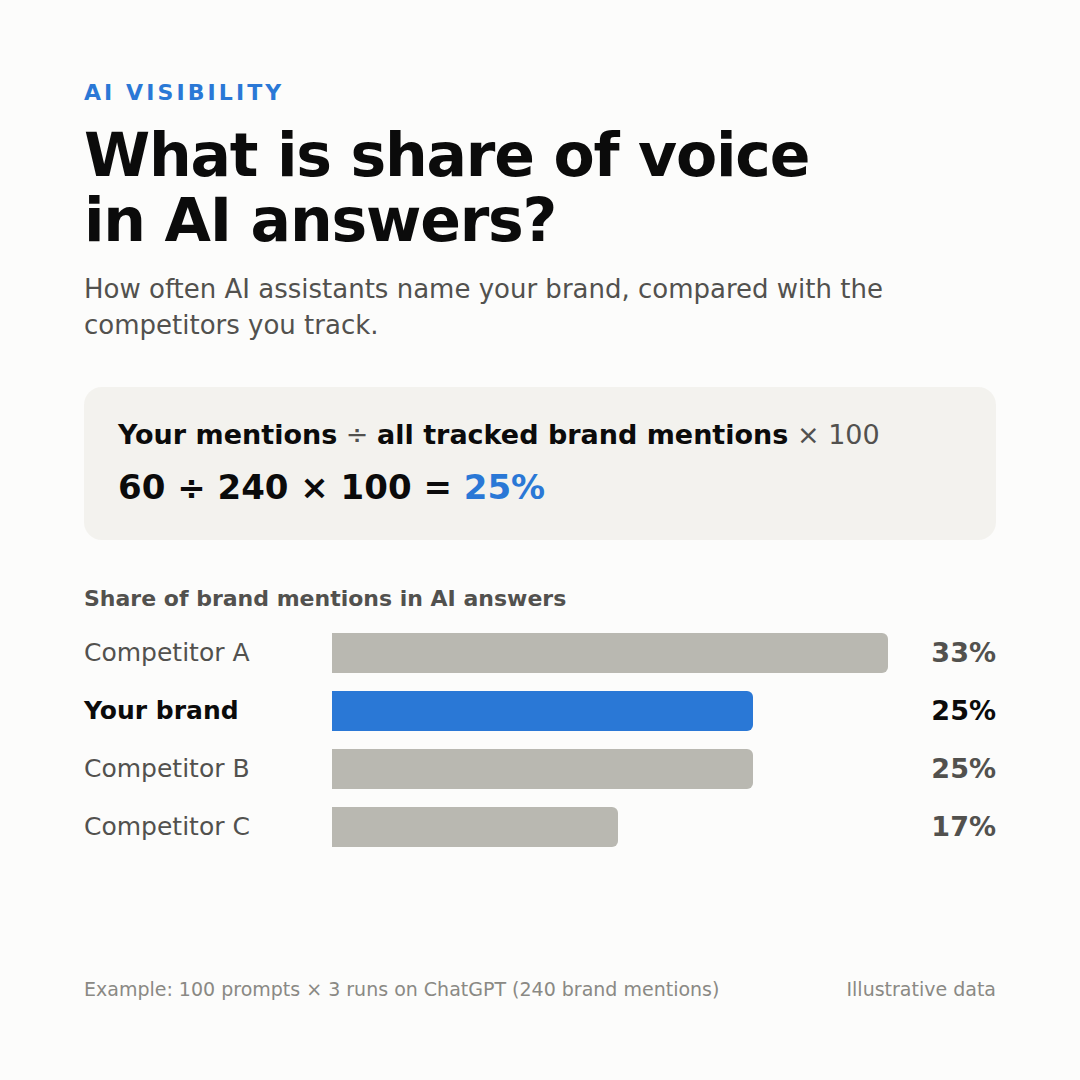
AI share of voice = (AI answers that mention your brand ÷ AI answers that mention any tracked brand) × 100
Getting to that number takes four steps.
1. Build a prompt set. Write down the questions your buyers ask. For a license management SaaS, that might be "best tools to track engineering software license usage" or "cheaper alternatives to [competitor]." Most teams track anywhere from a few dozen to a few hundred prompts, spread across early research, comparison and purchase.
2. Run each prompt many times. Use several platforms and a regular schedule, because one run tells you almost nothing.
3. Count the brand names. Scan every answer for your brand and for each competitor on your list.
4. Divide. Your mentions divided by all tracked mentions is your share.
Here's how that looks with real numbers. You run 100 prompts three times each on ChatGPT. Competitors get named 180 times and you get named 60 times. Your share of voice is 60 ÷ 240, or 25%.
The common variations
A passing mention and a first-place recommendation shouldn't count the same, so most tools report several versions of the metric.
- Mention share of voice. Did the AI name your brand at all? This is the baseline.
- Citation share of voice. Did the AI link to your website as a source? It's harder to earn, and it signals that the AI treats you as an authority.
- Position-weighted share of voice. Being recommended first counts for more than being listed fifth.
- Sentiment-adjusted share of voice. A warm recommendation counts for more than a neutral mention. A negative one can count against you.
- Segmented share of voice. The same metric split by platform, funnel stage, country or language. A brand can lead on Perplexity and not appear on Gemini at all.
Why it's harder to measure than classic share of voice
Ad spend is a fixed number. AI answers aren't.
In January 2026, SparkToro's Rand Fishkin and Gumshoe's Patrick O'Donnell had 600 volunteers run the same 12 prompts through ChatGPT, Claude and Google's AI nearly 3,000 times. The same list of brands came back less than 1% of the time. The same list in the same order came back about once in 1,000 runs. They concluded that tracking your rank position in AI answers is close to meaningless. Tracking how often you appear across many runs isn't.
That instability causes practical problems.
The platforms disagree with each other. Averi's analysis found only 11% overlap between the domains ChatGPT and Perplexity cite, so a strong score on one tells you little about another.
Your prompts shape your score. Pick prompts that play to your strengths and you'll look great. Treat the prompt list as a methodology decision, and have someone who talks to buyers review it.
Answers are personalized. Memory, location and chat history mean two buyers who ask the same question can get different answers. No tracking tool sees exactly what your prospect sees.
There's no industry standard. Each vendor samples and weights the metric differently, so 30% in one tool and 30% in another are different numbers.
Share of voice also measures presence on the shortlist, not revenue. It's a leading indicator. Pair it with AI referral traffic, demo requests and pipeline before you call it ROI in a board meeting.
How SaaS teams use "Share of Voice"
The most useful output isn't the headline percentage. It's the list of prompts where competitors appear and you don't. Each gap points to a comparison page you haven't written, or to review sites, "best tools" lists and Reddit threads where AI tools find your competitors and don't find you.
Teams also use it to benchmark against the three or four competitors they lose deals to. A monthly trend line tells you far more than a single snapshot.
It shows whether your work moved anything. When you publish a comparison page, get onto a category list or land press coverage, share of voice tells you whether AI answers changed afterward.
And it makes the budget conversation easier. Leadership already knows share of voice from advertising and PR, so you don't have to teach them a new concept before asking for money.
Which tools report AI share of voice
A new software category has grown around this metric, sold as AI visibility, answer engine optimization (AEO) or generative engine optimization (GEO). HubSpot's 2026 comparison of AEO software lists these tools as reporting share of voice:
- Otterly.ai (from $29/month): ChatGPT, Google AI, Perplexity, Microsoft Copilot
- Rank Prompt (from $49/month): ChatGPT, Gemini, Perplexity, Claude, Grok
- HubSpot AEO (from $50/month): ChatGPT, Gemini, Perplexity
- Peec AI (from $95/month): platforms you choose
- Semrush AI Visibility (from $99/month): ChatGPT, Google AI, Perplexity, Claude, Gemini
- Profound (from $99/month): ChatGPT, Perplexity, Google AI and others
- SE Ranking (from $129/month): Google AI, Gemini, ChatGPT
- Scrunch (from $250/month): ChatGPT, Google AI, Gemini, Perplexity and others
- Ahrefs Brand Radar (from $398/month): Google AI, ChatGPT, Perplexity, Gemini, Copilot
- AirOps (price not published): ChatGPT, Google AI, Perplexity, Gemini
Prices and platform coverage change fast, so check with each vendor before you buy. Which tool you pick matters less than using it consistently. Every tool measures differently, so choose one, keep your prompt set stable, and judge the trend over months, not a single score.
Start with the buyer questions your sales team hears every week. Run them this afternoon in ChatGPT, Perplexity and Gemini. Write down every brand that comes back. That's your first share-of-voice snapshot. It also shows you which competitor has been getting the "Claude suggested you" moment instead of you.